
Meta's Watermelon Is Matching GPT-5.5 — In Private

On July 5, 2026, Alexandr Wang — Meta's Chief AI Officer and head of Meta Superintelligence Labs — told employees in an internal town hall that the company's next flagship model, codenamed "Watermelon," has reached performance parity with OpenAI's GPT-5.5 on internal benchmarks. The model is still in training. No public release date has been announced.
That last sentence is worth sitting with. A model in training, benchmarked internally, compared against a rival nobody outside Meta has tested it against. The claim is significant. So is what's missing from it.
What Happened
Watermelon is the internal codename for Meta's next-generation AI model, developed inside Meta Superintelligence Labs (MSL), the division Wang built after joining Meta from Scale AI in 2025.
At the July 5 town hall, Wang reportedly told employees two specific things:
- Watermelon has caught up to GPT-5.5 on "closely followed industry benchmarks."
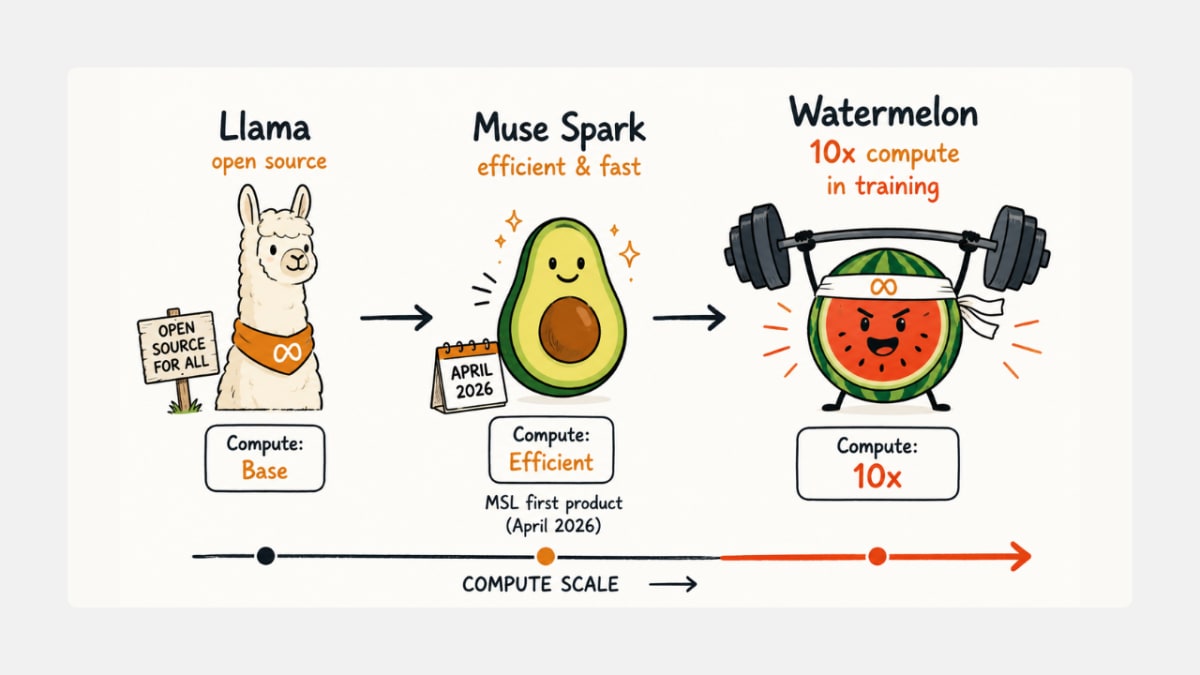
- The model uses an order of magnitude more compute than its predecessor, codenamed "Avocado."
Avocado is the internal name for the Muse Spark model family, released by Meta in April 2026 — the first product shipped by MSL. Muse Spark was positioned as a fast, efficient model. Watermelon is not positioned as efficient. It's positioned as capable.
The compute jump is the headline number here. "An order of magnitude more" means at least 10x the training compute. Meta's 2026 capital expenditure guidance is $125 billion to $145 billion, a figure that only makes sense if you believe Meta's robots bet pays off. Watermelon is what that spending is for.
GPT-5.5, the benchmark target, was released by OpenAI on April 23, 2026. It was designed specifically for complex, multi-step agentic tasks, with reported improvements in error recovery, tool-use efficiency, and long-horizon workflow handling. In Claude Opus 4.7 vs GPT-5.5 evaluations, GPT-5.5 was the stronger model for sustained agentic workloads. That is the bar Watermelon is now, internally, reportedly matching.
What It Actually Means
Does "benchmark parity with GPT-5.5" mean Watermelon is ready to compete?
Not yet, and possibly not for months. The claim is based on internal evaluations, the specific benchmarks were not disclosed publicly, and there has been no independent verification. OpenAI continues to iterate — reports of early previews for GPT-5.6 were already circulating before this town hall. Parity with a model released in April 2026 is progress, not a finish line.
The benchmark disclosure was also inside a town hall, not a paper or a blog post. Meta's choice to surface a training-phase result to employees — and, inevitably, to the press via leaks — reads as a morale and recruiting move as much as a technical one. That doesn't make the result false. It does mean the framing deserves scrutiny.
Why the compute bet is the more important signal
Here is the non-obvious thing about Watermelon: it marks the end of a specific version of Meta's AI identity.
For most of the last three years, Meta's AI strategy was open source. Llama models were the flagship. Free weights were the competitive moat. The logic was that open-source dominance would build the ecosystem Meta needed to matter in AI without having to out-spend OpenAI or Anthropic on proprietary development.
Watermelon is explicitly not that strategy. It is a proprietary, closed model trained at massive scale. The 10x compute jump over Avocado is not an efficiency play. It is a frontier play — a direct attempt to match GPT-5.5 on its own terms.
That pivot is significant because it acknowledges something the open-source positioning never quite admitted: that the frontier is still compute-bound, and that model weights alone do not get you there. Meta is now betting that $125B to $145B in infrastructure, Wang's team, and a model codenamed after summer fruit can put them in the room with OpenAI and Anthropic.
That is a real bet. Whether it's the right one depends heavily on whether Watermelon holds up under independent evaluation. Right now, OpenAI just admitted what Anthropic knew first about the path to frontier performance, and Anthropic's Claude Sonnet 5 has closed its own capability gap since June 2026. The frontier is moving fast. Catching up during training does not guarantee you're still caught up at release.
What Wang did not say
Wang reportedly did not disclose:
- The specific benchmarks used for comparison
- Whether the comparison involved the full GPT-5.5 or a specific capability subset
- Watermelon's context window, pricing structure, or intended deployment model
- A release timeline
These gaps are standard for a model in training. They are still worth naming. "Caught up to GPT-5.5 on benchmarks" means something different if the benchmarks are coding and math versus extended agentic task completion, where GPT-5.5 has been most differentiated.
Also not disclosed: whether agents have improved. In a separate context around the same period, Mark Zuckerberg noted that the development of AI agents at Meta had not accelerated as quickly as expected. Watermelon's benchmark claim is for raw model capability. Agentic performance is a separate question.
Who This Affects
Developers evaluating AI models for 2026–2027 infrastructure bets: Watermelon is not available yet. For now, GPT-5.5 and Claude Sonnet 5 are the production-available frontier options. The Watermelon announcement changes the competitive map for future planning but does not change today's API landscape. Do not wait for Watermelon before making current infrastructure decisions.
Teams building on Meta's ecosystem (Llama, Muse Spark): This signals that Meta's proprietary compute track is now the priority. Llama open weights are not going away, but the frontier investment is clearly in MSL's closed models. If you're building on open-source Llama expecting Meta to keep it at the frontier, adjust those expectations.
OpenAI and Anthropic's enterprise teams: A Meta model that genuinely matches GPT-5.5 on agentic benchmarks would be a serious competitive development. It would also be the first closed Meta model competing directly with OpenAI in the enterprise tier. The threat is real but not yet proven. Both companies have time to move before Watermelon ships.
What to Watch For Next
Independent benchmarking is the only number that will matter externally. When Watermelon is released or previewed, check LMSYS Chatbot Arena, Terminal-Bench, and any agentic evaluation suite for validated scores against GPT-5.5 and Claude Sonnet 5. Internal results are a starting point.
OpenAI is reportedly previewing GPT-5.6 already. If it ships before Watermelon does, Meta's parity claim becomes parity with a model that's no longer at the frontier. That's a real risk on a model still in training.
Wang has publicly signaled that a Muse Spark update focused on coding and agentic capabilities is coming "soon." That ship date is a preview of Meta's execution velocity for Watermelon.
Watch whether Meta previews Watermelon at any public research event before the end of Q3 2026. A public demo with external researchers would confirm the benchmark claims are real. A continued absence of any external preview would suggest the training gap is wider than the town hall framing implies.
The Bottom Line
Meta's Watermelon model is, internally, matching GPT-5.5 on benchmarks during training. That is a real milestone for a company whose previous AI models had a meaningful performance gap with the frontier. The 10x compute jump over Muse Spark is the clearest signal of where Meta's $145B infrastructure bet is going.
But the claim is internal, the benchmarks aren't disclosed, and the model isn't released. In a race where OpenAI is already previewing GPT-5.6, "caught up during training" is a promising position, not a finish line. Watch for independent evaluations. Until then, treat Watermelon as the most credible signal yet that Meta is serious about the frontier — not as proof they've reached it.
FAQ
What is Meta's Watermelon model?
Watermelon is the internal codename for Meta's next-generation proprietary AI model, developed by Meta Superintelligence Labs under Chief AI Officer Alexandr Wang. It is currently in training as of July 2026 and uses approximately 10 times the compute of its predecessor, Muse Spark (codenamed Avocado).
Has Watermelon been released publicly?
No. As of July 6, 2026, there is no announced public release date. The benchmark claim surfaced in an internal Meta town hall on July 5, 2026. The model remains in the training phase.
How does Watermelon compare to GPT-5.5?
According to Meta's internal reporting, Watermelon has reached performance parity with OpenAI's GPT-5.5 on internal benchmarks. The specific benchmarks were not publicly disclosed, and there has been no independent third-party verification of this claim.
What happened to Meta's open-source AI strategy?
Meta's open Llama model line continues, but Watermelon represents a shift toward massive proprietary closed models at the frontier. This is a meaningful departure from the open-weights strategy that defined Meta's AI positioning for most of 2023–2025.