
Hugging Face’s Microduck Is a Pet for AI Builders
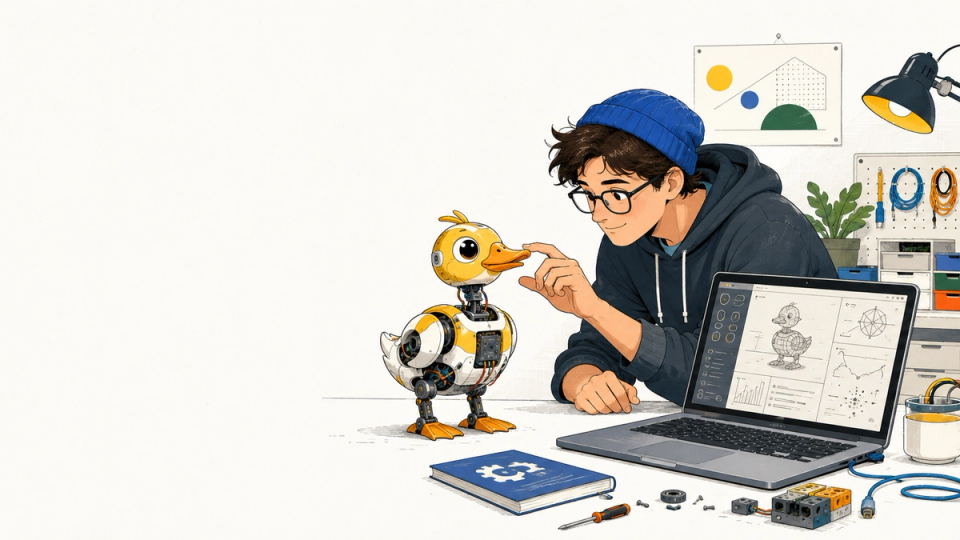
Hugging Face’s Microduck is a 25 cm open-source bipedal robot that runs reinforcement-learning policies and ships with seven trained behaviors. It costs $399 before taxes and shipping, and its software, simulator, and training stack are published for people to inspect, retrain, and share. (Pollen Robotics product page)
The important story is not that an AI company made a cute duck. The important story is that Hugging Face and Pollen Robotics are packaging embodiment as a personal learning loop: simulate a behavior, deploy it, refine it, and publish the policy. That makes Microduck closer to a physical open-source project than a smart speaker with feet.
For the right buyer, this is a genuinely interesting personal AI pet. For everyone else, it is a $399 dev kit that happens to waddle. The distinction matters because the product’s value will come from what its community teaches it, not from the seven tricks in the box.
The short answer
What is Microduck?
A small, open-source robot from Pollen Robotics, part of the Hugging Face ecosystem, with 15 motors, a camera, lidar, two IMUs, Wi-Fi, Bluetooth, and a 50 Hz onboard control loop. It can walk, sit, stand, kick, grab, roller-skate, and recover from lying on its back. (Pollen Robotics technical specifications)
Why does it matter?
Most consumer robots hide the interesting layer behind a polished app. Microduck exposes the policy, simulator, runtime, and training workflow. Its owner is invited to modify the behavior itself, not merely choose from a menu of behaviors.
The non-obvious truth: Microduck is not mainly a companion product. It is a physical interface for learning robotics. The pet framing lowers the emotional barrier, while the open stack turns every owner into a potential contributor, tester, and teacher.
What Hugging Face actually launched
The launch is easy to misread because the object is doing several jobs at once.
As hardware, Microduck is a roughly 25 cm, 800 g biped with 15 motors. Its product page lists a camera, lidar, two inertial measurement units, a battery, and a 50 Hz onboard policy loop. The base robot includes a game controller, which means it is playable immediately rather than waiting for a training pipeline. (Pollen Robotics product page)
As software, it is a stack rather than a single model. The public runtime repository describes a Rockchip RK3566 board, a 50 Hz control loop, fifteen servos, the camera, radios, and update machinery. Its companion reinforcement-learning repository uses MuJoCo and PPO, exports policies to ONNX, and deploys them on the physical robot. (Microduck runtime repository, Microduck RL repository)
As a community product, it is a swap-meet for behaviors. Pollen says owners can train in simulation, deploy on the robot, refine the simulation, and publish a policy. The official stack is released under Apache 2.0, and the project points builders toward a Discord community for sharing builds and debugging strange legs. (Pollen Robotics open-source overview)
That combination is unusual. A robot can be open hardware but closed in software. A robotics simulator can be open but disconnected from affordable hardware. A consumer device can be charming but impossible to teach. Microduck is trying to connect all three.
Why is a robot duck a better personal AI experiment than a chatbot?
Because the body creates consequences. A chatbot can claim it learned a preference without changing what it can do. A robot has to keep its balance, respect its motor limits, interpret sensor readings, and survive contact with the floor. Embodiment turns “learning” from a personality metaphor into a measurable control problem.
The product’s language is deliberately friendly, but the underlying loop is serious. Reinforcement learning trains a policy to map observations and commands to actions. In Microduck’s case, the policy is not generating a paragraph about walking. It is producing motor targets quickly enough to keep a small body upright.
The official RL repository says policies are trained at 50 Hz, exported to ONNX, and deployed through the runtime. It also describes the sim-to-real recipe, including actuator physics, domain randomization, and backlash simulation. Those details are the difference between a demo and a transferable training system. (Microduck RL repository)
This is where the pet framing helps. A researcher may understand a locomotion policy, but a curious teenager understands “teach the duck to do something new.” The social object makes a hard technical loop legible. You can see whether the behavior works. You can show it to someone who does not care about PPO.
The same pattern is visible in the open-source local AI assistant landscape. Running a model locally matters because ownership changes the workflow: you can inspect it, route it, and adapt it. Microduck pushes that logic into the physical world. The model is not just yours to query. The behavior is yours to retrain.
What does “teach it” really mean here?
It does not mean talking to the robot until it develops a personality. It means changing or training a control policy, usually in simulation, then testing whether that policy transfers to hardware. “Teach” is a friendly name for an engineering workflow with failure modes.
Pollen’s recommended loop has four steps: train in simulation, deploy on the robot, refine the simulation, and publish the policy. That is a sensible order because simulation is cheaper, safer, and faster to reset than a physical robot. You can damage less hardware while exploring more behaviors. (Pollen Robotics product page)
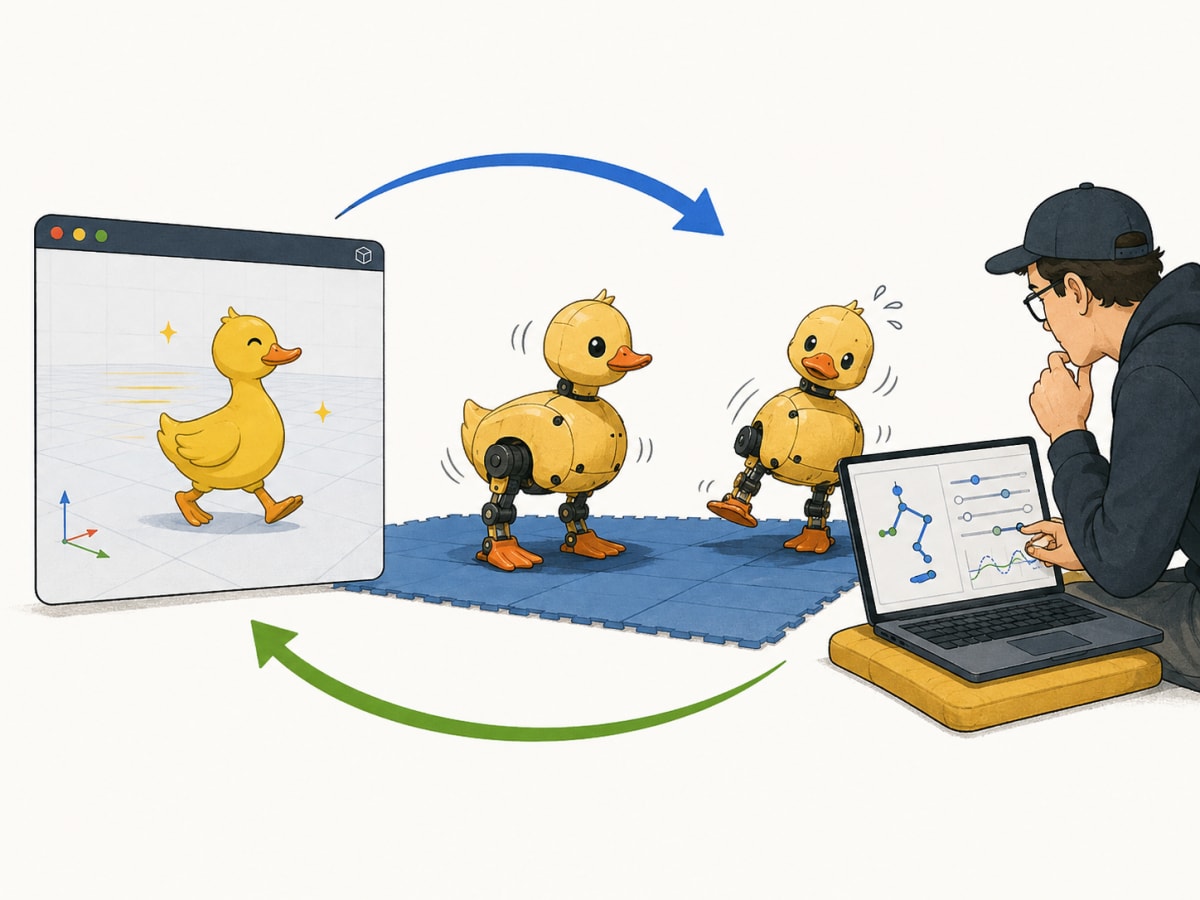
The simulator is not merely a visualization. The official Hugging Face Space runs a Microduck RL playground in the browser, with MuJoCo compiled to WebAssembly and ONNX Runtime Web executing the policy. Its README says the simulator exposes the same policy interface for walking and roller modes, including a 61-dimensional observation and 14 position targets. (Microduck Sandbox on Hugging Face, browser simulator documentation)
That gives the product a useful progression:
- Try an existing policy in the browser.
- Drive the physical robot with a controller.
- Change a reward, observation, or behavior in simulation.
- Test the result on a padded floor with an emergency stop.
- Publish the policy only after documenting what it can and cannot do.
The fifth step is important. An open policy is not automatically a safe policy. One community model card already makes the distinction explicit: a policy for stepping up and recovering is simulation-validated but hardware-unvalidated, and its author recommends a support rig, tether, padded floor, and emergency stop for first physical trials. (Community Microduck policy card)
That is what “teachable” should mean in practice. Not magic. A reproducible path from an experiment to a behavior, with a clear label for the gap between simulation and reality.
Is Microduck an AI companion or a robotics kit?
Today, it is much more convincingly a robotics kit. The product has a camera, speaker, microphone, radios, and lidar, but the published headline is locomotion and behavior training. Nothing in the public launch material proves that it is a persistent conversational companion with memory, reliable social interaction, or a general-purpose assistant model.
That is not a criticism. It is a useful boundary.
The word “AI pet” carries expectations that the product does not need to satisfy. People imagine a creature that recognizes them, remembers yesterday, reacts with emotional continuity, and invents games. Microduck can become a body for those experiments, but the owner or community still has to build the perception, conversation, memory, and behavior orchestration around it.
The better comparison is a personal computer in the early hobbyist era. The hardware is appealing on its own, but the real value comes from what you learn to make it do. If you want a finished companion, a closed consumer robot may be less work. If you want to understand how a model crosses from perception to action, Microduck is far more interesting.
This is also why its relationship with Hugging Face matters. Hugging Face is strongest when it turns a model or dataset into a shared artifact: something people can download, fork, evaluate, and improve. The Microduck simulator already appears as a Hugging Face Space, and the robotics stack is designed around public repositories and exchangeable policies. (Microduck Sandbox, Hugging Face model and Space platform)
The robot is a physical repository with legs. The policy is the pull request.
Why the $399 price is both smart and dangerous
At $399 before taxes and shipping, Microduck is cheap by robotics standards and expensive by toy standards. That middle position is the whole bet. The price is low enough for a serious maker, lab, or education program to consider, but high enough that the owner will expect more than a novelty.
The base package includes the robot, battery, USB-C cable, and game controller. Pollen lists a $39 charger pack, a $119 development pack, and a $39 accessory pack. A buyer who wants spare motors, extra batteries, NFC tags, and the tools to work on the robot can therefore spend materially more than the headline price. (Pollen Robotics product page)
The smart part of the pricing is that the first experience is not “assemble a robot and hope.” The robot ships playable, with seven behaviors listed on the product page. That gives the owner an immediate toy and a baseline for experimentation.
The dangerous part is support. A $399 robot can only feel accessible if the software installation, calibration, policy export, firmware updates, motor replacement, and first sim-to-real experiment are documented for people who are not robotics specialists. Open source moves the ceiling upward, but it can also move the onboarding burden onto the buyer.
The product’s public repositories show that the team understands this. The runtime includes a verified, health-gated, reversible update path, and the documentation includes a Bluetooth control tool that works without network access or SSH. Those are unglamorous details, but they are exactly what makes an open robot usable after the launch video ends. (Microduck runtime repository)
The buying rule is simple: purchase Microduck if you would enjoy the training process even when the behavior fails. Do not purchase it if your satisfaction depends on a polished companion experience on day one.
What will decide whether Microduck becomes a platform?
The hardware is good enough to start the experiment. The community will decide whether it becomes a platform.
The first signal is policy diversity. If most owners only run the bundled seven behaviors, Microduck remains a charming programmable toy. If people publish robust new behaviors, better simulation environments, perception modules, voice interfaces, and educational lessons, it becomes a shared physical-AI substrate.
The second signal is reproducibility. A policy demo that works once on one duck is content. A policy with environment details, sensor assumptions, training configuration, safety limits, and a reliable install path is infrastructure. Hugging Face’s culture gives the project a natural place to reward the second kind of contribution.
The third signal is transfer quality. Sim-to-real is the promise and the bottleneck. A simulation can teach a policy to walk under one set of assumptions. The real floor has friction, loose cables, imperfect motors, battery sag, and objects the simulator forgot. The more that community experiments expose and reduce those gaps, the more valuable the platform becomes.
The fourth signal is whether people build useful upper layers. A walking policy is technically satisfying. A robot that can recognize a person, respond to a local voice command, navigate a desk, or run a small household routine is more likely to become a personal AI pet. That layer will probably combine conventional robotics, speech, vision, and language models. Microduck’s open runtime gives builders a place to attach those systems, but it does not supply them automatically.
The pattern resembles the lesson from AI benchmarks are misleading: capability is not the same as a reliable loop. A clever policy does not make a dependable robot. Reliability comes from feedback, bounded actions, observability, and recovery after the physical world disagrees.
The honest take
The first limit is that this is a launch-stage product. The public material establishes the specifications, repositories, simulator, and intended workflow. It does not establish long-term battery life, motor durability, latency under every workload, the size of the support community, or how many owners will successfully train a new policy. Those are open questions, not facts to fill with enthusiasm.
The second limit is that open source does not remove the cost of hardware. A software policy can be forked for free. A failed experiment can still strip a gear, bend a linkage, or consume an evening of debugging. The community policy warning about support rigs and padded floors is a reminder that sim-to-real has a physical blast radius.
The third limit is privacy. A robot with a camera, microphone, Wi-Fi, Bluetooth, and lidar belongs in a room, not just a benchmark. The public runtime documentation makes the control surface inspectable, which helps. It does not by itself answer where every recording goes, what is retained, or how a household should configure network access. Buyers should verify those details before placing it near private conversations.
The fourth limit is the companion claim. Calling Microduck a personal AI pet is a useful invitation, not a demonstrated product category. The launch proves a teachable robot with a friendly body. It does not prove memory, emotional continuity, or autonomous household usefulness. Those will be community projects, and some will work better than others.
The bottom line
Microduck is the most interesting kind of AI pet: one that exposes the learning loop instead of pretending the loop does not exist.
At $399, it gives makers a physical robot, a simulator, a runtime, and a public reinforcement-learning stack. That is a strong proposition for people who want to learn embodied AI, teach workshops, or build a local assistant with an actual body. It is a weak proposition for anyone looking for a finished digital companion in duck form.
The decision rule is therefore practical. Buy it for the experiment, not the promise. Start in the browser simulator, read the runtime and RL repositories, budget for safety equipment and replacement parts, and treat every physical deployment as a test. If the community makes the policy layer easy to share, Microduck could become a small but important bridge between open models and open machines.
Frequently asked questions
Is Microduck made by Hugging Face?
Microduck is presented by Pollen Robotics, whose product page identifies the project as part of the Hugging Face ecosystem. The robot’s simulator appears on Hugging Face, and the public product page links to Hugging Face as the parent ecosystem. (Pollen Robotics)
How much does Microduck cost?
The introductory price is $399 before taxes and shipping. Optional packs include a $39 charger pack, a $119 development pack, and a $39 accessory pack. Prices and availability can change, so check the official product page before ordering. (Pollen Robotics pricing)
Can Microduck learn new tricks?
Yes, in the engineering sense. Pollen describes a workflow for training behaviors in simulation, deploying them to the robot, refining the simulation, and publishing the resulting policy. New behaviors require robotics and reinforcement-learning work, not simply a natural-language request.
Does Microduck use a large language model?
The launch materials focus on reinforcement-learning locomotion policies, not on a built-in large language model or general conversational assistant. Its camera, speaker, and microphone could support language and vision integrations, but those should be treated as projects to build or verify rather than assumed features.
Can I try Microduck without buying the robot?
Yes. The Microduck Sandbox on Hugging Face provides a browser-based simulator, and its documentation describes running trained policies in the browser. It is a useful first step for understanding the control loop before spending money on hardware. (Microduck Sandbox)
Is it safe to train a custom policy on the real robot?
Physical experiments need safeguards. A community policy card recommends a support rig, tether, padded floor, and emergency stop for a simulation-validated policy that has not yet run on hardware. Treat simulation success and hardware validation as separate milestones. (Example community policy card)