
AI Assistance Ends Where AI Decision-Making Begins
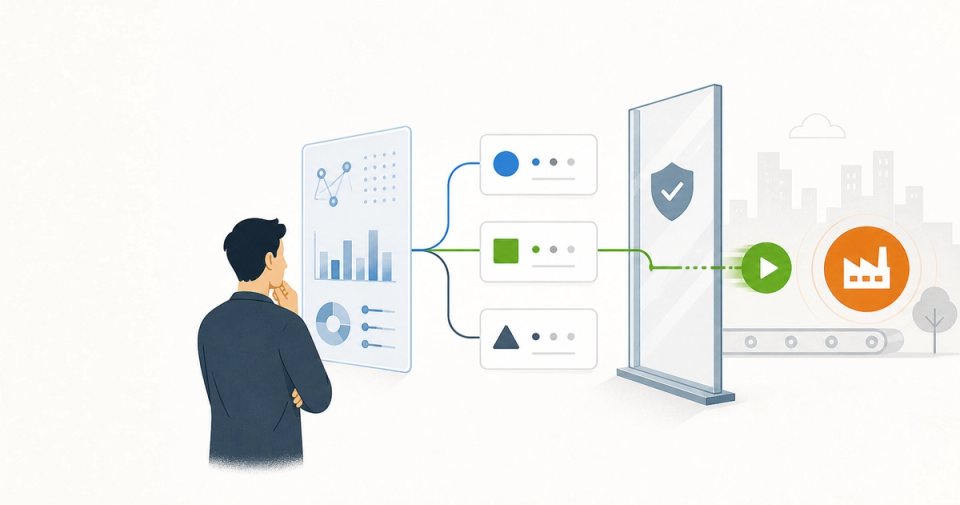
AI assistance helps a person decide; AI decision-making decides what happens next. The difference is not whether a model sounds confident or whether a human is somewhere in the loop. It is who owns the choice, what authority the system has, and whether anyone can meaningfully inspect or reverse the result.
The thesis is simple: teams should treat AI as an assistant until they can name the decision right they are delegating, the evidence that justifies it, and the recovery path when it is wrong. A polished recommendation can quietly become a decision when it is auto-applied, routed, ranked, or allowed to trigger a side effect. The dangerous transition is usually a product setting, not a dramatic leap in model intelligence.
This matters now because agentic systems are moving from generating text to selecting tools, prioritizing work, changing records, and executing workflows. NIST’s AI Risk Management Framework explicitly distinguishes systems that decide autonomously, defer to a human expert, or provide an additional opinion to a human decision maker. The operating question is no longer whether a model is “in the loop.” It is whether the human still has the information, time, authority, and practical ability to disagree.
The thesis: assistance is a capability; decision-making is a responsibility
An assistant produces an input to a decision: a summary, forecast, draft, classification, recommendation, ranked list, or simulation. A decision-maker selects an outcome and accepts responsibility for its consequences. The same model output can be assistance in one workflow and decision-making in another.
A support agent that summarizes a customer’s case is assisting. A support agent that automatically closes the case, refunds the customer, or denies escalation is deciding. A coding agent that proposes a patch is assisting. An agent that merges the patch to production without a defined review gate is deciding that the change is safe enough to ship. A hiring model that surfaces candidates is assisting; one that silently removes candidates from consideration is deciding.
That boundary is easy to miss because modern software hides decisions behind defaults. “Auto-apply,” “recommended route,” “best match,” and “send without review” sound like convenience features. Operationally, they transfer authority.
OpenAI’s explanation of its Model Spec makes the same point from another angle: intelligence alone does not determine ethical tradeoffs, and if the only rule is “be helpful and safe,” there is no mechanism for humans to debate where the boundary should sit. A capable model can produce a plausible answer. It cannot, by capability alone, decide which values, constraints, or risks an organization is authorized to accept.
The quick answer
What is AI assistance?
A system generates analysis or options while an accountable person or explicit policy still chooses the outcome.
What is AI decision-making?
A system selects, commits, or triggers an outcome with enough authority that the human role is merely notification, rubber-stamping, or cleanup.
The non-obvious truth: “Human in the loop” is not a control unless the human can understand the recommendation, has time to challenge it, and can stop or reverse the consequence. Otherwise the system has delegated the decision while preserving the appearance of oversight.
What does the human-in-the-loop phrase get wrong?
A human-in-the-loop system can still be functionally autonomous if the person only approves what the system has already made difficult to question. Oversight is real when the reviewer has decision rights, relevant evidence, enough time, and a practical veto. A click-through approval screen is workflow decoration, not governance.
The first failure is automation bias: people tend to accept a machine recommendation because it appears objective, consistent, or expensive to challenge. The second is alert fatigue: if every item requires approval, reviewers learn to approve quickly. The third is accountability laundering: the organization says “the human approved it” after designing a process in which disagreement is slow, undocumented, or punished.
NIST’s guidance is more demanding than a checkbox. Its human-AI interaction appendix says roles and responsibilities should be clearly defined and differentiated across configurations that range from fully manual to fully autonomous. That distinction matters because “reviewer,” “operator,” “owner,” and “appeal authority” are not synonyms.
A useful test is to remove the model’s recommendation and ask whether the human could still make the decision from the available evidence. If the answer is no, the system has not merely assisted. It has become the practical decision-maker while the human supplies legitimacy after the fact.
When does a recommendation become a decision?
A recommendation becomes a decision when the system’s output changes the default outcome, controls access to the next step, or causes an external side effect without a meaningful opportunity to challenge it. The threshold is operational, not linguistic: ranking, routing, suppression, execution, and irreversible timing can all carry decision authority.
Consider four ways authority moves from a person to a system:
- Selection: the model chooses one option instead of presenting alternatives.
- Ordering: the model determines what gets attention first, shaping scarce human time.
- Permission: the model decides who or what can proceed.
- Execution: the model changes a record, sends a message, spends money, or deploys code.
Selection and ordering are often treated as harmless because no button says “decide.” But a queue that places one customer first and another last is allocating service capacity. A fraud score that determines which transactions are investigated is allocating scrutiny. A content classifier that suppresses a post is exercising a policy, even if the final action is implemented by a separate rules engine.
The right design question is not “Does the model make the final decision?” It is “Which part of the outcome can no longer happen without the model?” If the model controls the only path to consideration, its ranking is a decision. If it controls the only path to execution, its tool call is a decision.
Anthropic draws a related architectural distinction between workflows, where models and tools follow predefined code paths, and agents, where the model dynamically directs its own process and tool use. That distinction is useful here: a deterministic workflow can constrain an assistant’s authority, while a dynamic agent needs explicit limits on what it may select, infer, and execute.
Which decisions should AI never own by default?
AI should not own a decision by default when the outcome affects rights, livelihood, safety, legal position, or irreversible resources and the relevant values cannot be reduced to a verified rule. In those cases, AI can gather evidence and expose tradeoffs, but an accountable human or institution must retain the authority to choose.
This is not an argument for manual work everywhere. It is an argument for matching autonomy to reversibility and contestability. Automatically sorting duplicate files is easy to reverse and has a narrow value question. Automatically denying insurance coverage, firing an employee, changing a medication plan, or deploying a security policy is harder to reverse and embeds judgments that require context.
Use four questions before delegating a decision:
- What is the cost of a false positive and a false negative? A recommendation can tolerate uncertainty differently from an enforcement action.
- Can the affected person contest the result? If there is no appeal path, the system needs a higher bar before acting.
- Can the outcome be reversed cleanly? A database rollback is not the same as restoring lost trust, income, or safety.
- Can the organization explain who authorized the policy? A model output is not a policy decision.
NIST’s AI RMF also warns that converting complex human phenomena into measurable quantities can remove context that is necessary to understand individual and societal impacts. That is the core limitation of automated judgment: the system may be very good at optimizing the variable it can see while being unable to know which unmeasured context should override it.
The decision-rights matrix
The most useful artifact is not an AI policy paragraph. It is a small matrix for each workflow. Write down the action, the model’s role, the authority boundary, the review condition, and the recovery path.
| Workflow | AI may do | AI may not do by default | Human or policy owner | Escalate when |
|---|---|---|---|---|
| Customer support | Summarize, classify intent, draft reply | Promise compensation or close a dispute | Support policy owner | Low confidence, vulnerable customer, refund above threshold |
| Hiring | Normalize applications, surface evidence, draft interview questions | Reject a person solely from an opaque score | Hiring manager and employment policy owner | Missing evidence, protected-category risk, candidate appeal |
| Coding | Explore files, propose patch, run tests, explain diff | Merge or deploy a high-impact change without a gate | Code owner and release policy | Test disagreement, security finding, unclear blast radius |
| Finance operations | Reconcile records, flag anomalies, draft payment batch | Release funds or alter approval limits | Finance approver | New beneficiary, unusual amount, failed reconciliation |
| Security | Correlate signals, propose containment, generate investigation steps | Disable critical access or destroy evidence without policy authorization | Security incident commander | Ambiguous identity, production impact, uncertain scope |
The matrix makes a hidden choice visible: autonomy is not one setting. It is a set of permissions attached to specific actions. A model might be allowed to draft a refund response, recommend a refund amount, and submit a refund request to a queue—but not authorize the payment.
Why does “more intelligence” not solve the delegation problem?
A smarter model can improve predictions, explanations, and plans, but it does not create authority, accountability, or shared values. Better reasoning reduces some execution errors; it does not answer whether the system is allowed to choose the outcome or whether the organization can defend that choice.
This is why swapping models is often the wrong response to a governance failure. If an agent has broad permissions, ambiguous objectives, weak verification, and no recovery path, increasing its intelligence may simply let it pursue the wrong objective more competently. Our earlier analysis of why AI agents fail even when the model is smart makes the same systems point: reliability depends on state, tools, verification, and stopping conditions—not just the model’s reasoning score.
Benchmarks do not settle the question either. A model can score well on a static task while still being the wrong component for a consequential workflow. The relevant evaluation is whether the complete system makes the right decision under the actual constraints: incomplete evidence, conflicting instructions, time pressure, retries, and human disagreement. That is why a workflow-specific AI evaluation is more informative than a leaderboard score when deciding how much authority to delegate.
The operating rule: delegate actions before judgments
Teams usually get safer results by automating bounded actions before automating open-ended judgments. Let the model extract fields, compare documents, draft changes, run tests, and identify anomalies. Keep policy interpretation, exception handling, irreversible commitments, and value-laden tradeoffs with a named owner until the system has evidence strong enough to justify more autonomy.
This rule also improves product design. Instead of asking an agent to “handle this customer,” define allowed actions: read the account, summarize the history, draft a response, propose a credit under $50, and escalate if the customer disputes a charge. Instead of “fix the bug,” define: inspect the repository, reproduce the test failure, propose a patch, run the suite, and open a pull request.
The more specific the action boundary, the easier it is to test. The more open-ended the objective, the more the organization is delegating judgment rather than assistance.
For tool-using systems, the boundary should be enforced at the tool layer, not only in the prompt. A pre-tool-access safety checklist can turn vague intent into explicit permissions. In production, authentication, permissions, logging, and failure recovery need to be separate controls: a valid identity does not prove that the model may perform this action, and a successful tool call does not prove that the resulting state is safe.
The honest take
The boundary is not binary. Every organization already delegates some decisions to software: tax calculations, routing rules, access controls, and duplicate detection. The practical question is whether the rule is explicit, testable, reversible, and appropriate to the stakes. Calling every automated rule “AI decision-making” would make the category too broad to guide design.
Human review can fail. Humans are not automatically wiser than models. They bring fatigue, bias, incentives, and incomplete context. A human gate is valuable only when the reviewer has a clear policy, useful evidence, adequate time, and authority to disagree. Otherwise a model may be less accountable than the person who rubber-stamps it, but not necessarily less accurate.
The article’s framework is not a legal test. Whether a system is legally considered to make a decision depends on the sector, jurisdiction, purpose, and implementation details. The matrix is an engineering and governance tool. It helps a team name its control boundary; it does not replace legal, clinical, employment, financial, or security review.
Some decisions are unknowable in advance. An agent may encounter an edge case that the matrix did not anticipate. That is why escalation, audit evidence, and reversibility matter as much as the initial permission. A system that cannot explain what it did or recover from an unknown outcome is not ready for broad autonomy, no matter how impressive its demos are.
The bottom line
AI assistance and AI decision-making are separated by authority, not by tone. If the system proposes, explains, simulates, or drafts while a person or explicit policy chooses, it is assisting. If it selects the only viable path, controls access to consideration, or triggers an external consequence, it is making a decision in practice.
Before deploying an agent, write the decision-rights matrix. Name what the model may observe, suggest, select, execute, and never do by default. Add an escalation path for uncertainty, a reviewer with real veto power, and a recovery plan for wrong or ambiguous outcomes. Increase autonomy only when the system has earned it with workflow-specific evidence.
The goal is not to keep AI out of decisions. It is to stop organizations from delegating decisions accidentally—and discovering the transfer of responsibility only after the system has already acted.